Home · Procedures · Facelift
Facial rejuvenation surgery · Bogotá
Deep Plane Facelift in Bogotá
Structural facial rejuvenation
A structural approach to facial rejuvenation designed to reposition descended tissues, restore support and improve facial–neck proportions while preserving identity.
Otolaryngologist · Facial plastic surgeon · More than three decades devoted to the face
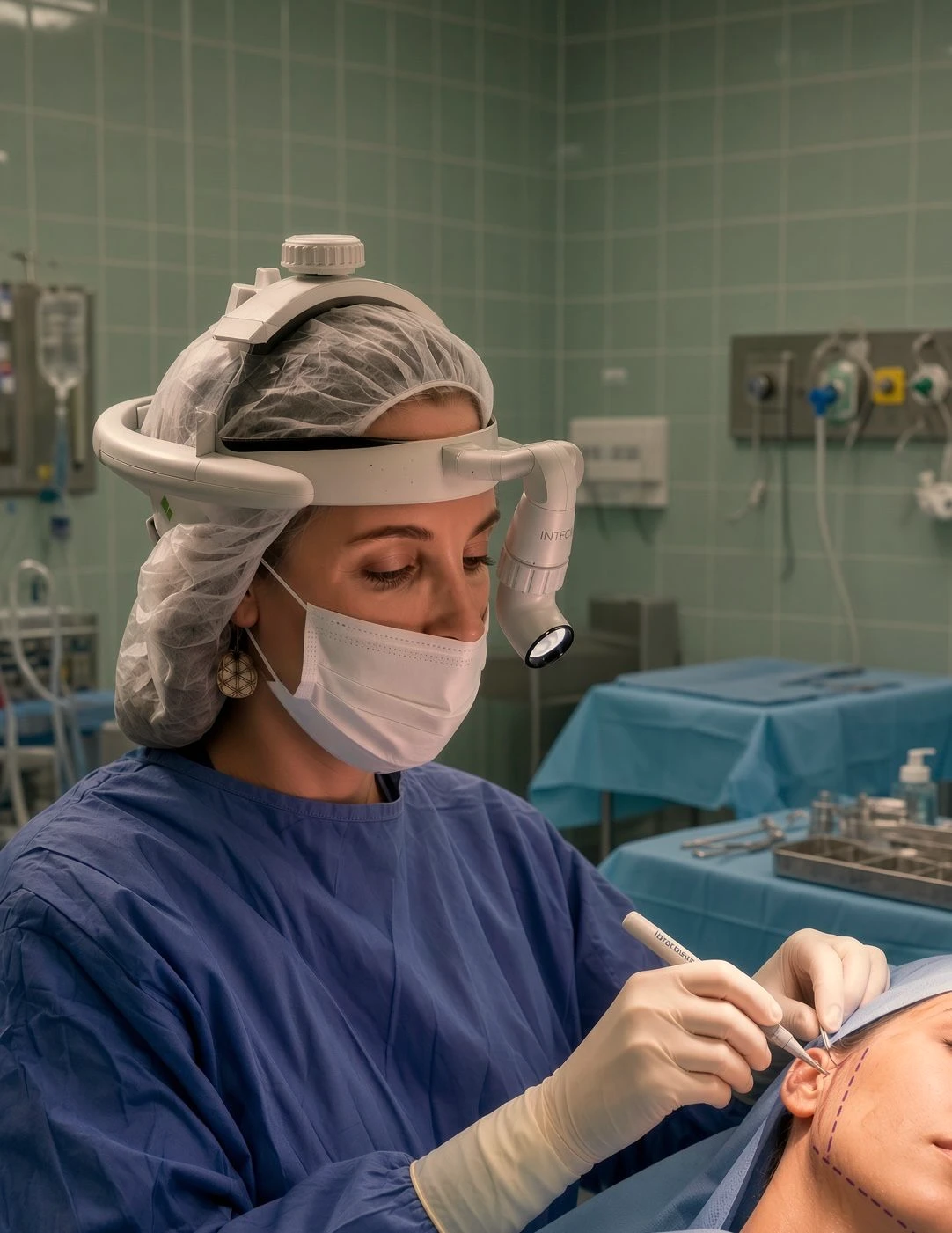
A Deep Plane Facelift works within the deeper anatomical planes of the face to reposition descended tissues rather than tightening the skin alone. The technique is chosen after the diagnosis, not before: the evaluation begins by understanding what has aged and what deserves to be preserved.
The essential question
What is a Deep Plane Facelift?
A Deep Plane Facelift is a facial rejuvenation approach that works within deeper anatomical planes, allowing descended facial tissues to be mobilized and repositioned rather than relying on skin tension alone.
Its purpose is to restore support, proportion and continuity between the face and neck, according to the anatomy of each patient.
It may be considered when facial aging involves cheek descent, loss of jawline definition, jowls, folds associated with tissue descent, facial or neck laxity, or changes in the relationship between the lower face and neck.
The indication and surgical approach must be individualized according to anatomy, tissue quality, previous surgery and the goals of each patient.
What has changed
Facial aging is structural, not only superficial.
Over time, the face does not simply lose firmness in the skin: the deep support, the ligaments and the position of the tissues all change. The jawline loses definition, the mid-face descends and the neck relaxes. Recognizing which component truly explains the change —support, volume or skin quality— is what determines whether a facelift is indicated and to what extent.
Before deciding
A facelift is not indicated by age or by a photograph.
It is indicated after understanding which structure has lost support, what must be preserved, and whether surgery is truly the best option for that face at that moment. This is the difference between choosing a technique and resolving a diagnosis.
Before the technique comes the question: what has aged, and what deserves to be kept?
What it can correct
Structure, definition and proportion.
Depending on each patient's anatomy, and when it is indicated, a facelift can address:
- Descent of the mid-face and of the tissues of the cheek.
- Loss of definition along the jawline.
- Laxity and descent of the neck and the cervicomental angle.
- Folds and creases associated with tissue descent.
Every indication is determined individually. The aim is not to alter the features, but to restore the support the face has lost.
Structural evaluation
The evaluation reads the face as a single unit: mid-face, jawline, neck, skin quality, surgical history, proportion and identity. That map defines the strategy.
Deep plane and other techniques
The technique is chosen to fit the anatomy, not the other way around.
Facelift techniques do not necessarily work on the same planes or share the same indication. A Deep Plane Facelift addresses the deeper planes and aims to mobilize the facial tissues as a structural unit, while other approaches may focus on different anatomical levels or patterns of aging. No technique is universally superior: the choice depends on the anatomy, the biological age of the tissues, previous surgery, the degree of descent and each person's goals.
The right question is not “which technique is best?” but “what does this face need?”.
In many cases, the face and neck are assessed and treated together, because aging of the lower third and the neck is related. Neck lift and cervical rejuvenation →
The decision
When it makes sense, and when it does not.
May be a candidate
- Structural changes in the support of the face and/or neck.
- Descent that no longer responds to surface treatments.
- Good general health and realistic expectations.
- A wish for a natural result that preserves identity.
When not to operate
- When the change is explained by volume or skin, not by support.
- When a non-surgical approach may be enough.
- When it is wiser to wait or to complete another stage first.
- When the expectation does not match what surgery can offer.
Being able to operate does not mean one should operate.
A second opinion can also confirm that the best course is not to intervene →

Recovery
Care throughout the process.
Recovery varies with the technique and with each patient. The timelines, the care and the follow-up visits are explained individually before surgery and are accompanied throughout the entire course. The same physician conducts the follow-up.
Risks
Explained, not minimized.
Every surgical procedure carries risks, limitations and possible complications. Specific information on risks, benefits, alternatives and expectations is part of the evaluation and the informed-consent process.
Clinical cases
Each face calls for a different decision.
A selection of clinical cases and their outcomes.
Clinical criterion
The Deep Plane Facelift, within a wider decision.
Dr. Alexandra Mora integrates the Deep Plane Facelift within a broader concept of structural facial rejuvenation. It is not an end in itself: it is one of the possible decisions within a strategy that integrates structural diagnosis, proportion, tissue quality, preservation of identity, therapeutic restraint and long-term planning, supported by decision frameworks such as the Facial Integrity Scale™ (FIS™). That is why the conversation does not begin with the technique, but with understanding the face.
Frequently asked questions
About the Deep Plane Facelift.
What is a Deep Plane Facelift?
Does a Deep Plane Facelift also improve the neck?
Does a Deep Plane Facelift change the features?
Is a Deep Plane Facelift better than other types of facelift?
How do I know if I am a candidate for a Deep Plane Facelift?
The decision begins with the diagnosis.
An evaluation determines whether a Deep Plane Facelift, another facelift technique or even a different strategy is the most appropriate next step for your face.
Centro Médico Almirante Colón · Carrera 16 No. 84A-09, Office 723 · Bogotá D.C. · Care in Spanish, English and French.
Medically reviewed by Alexandra Mora Hernández, MD · Last reviewed: 21 September 2026. Educational content; it does not replace an individual medical assessment.